
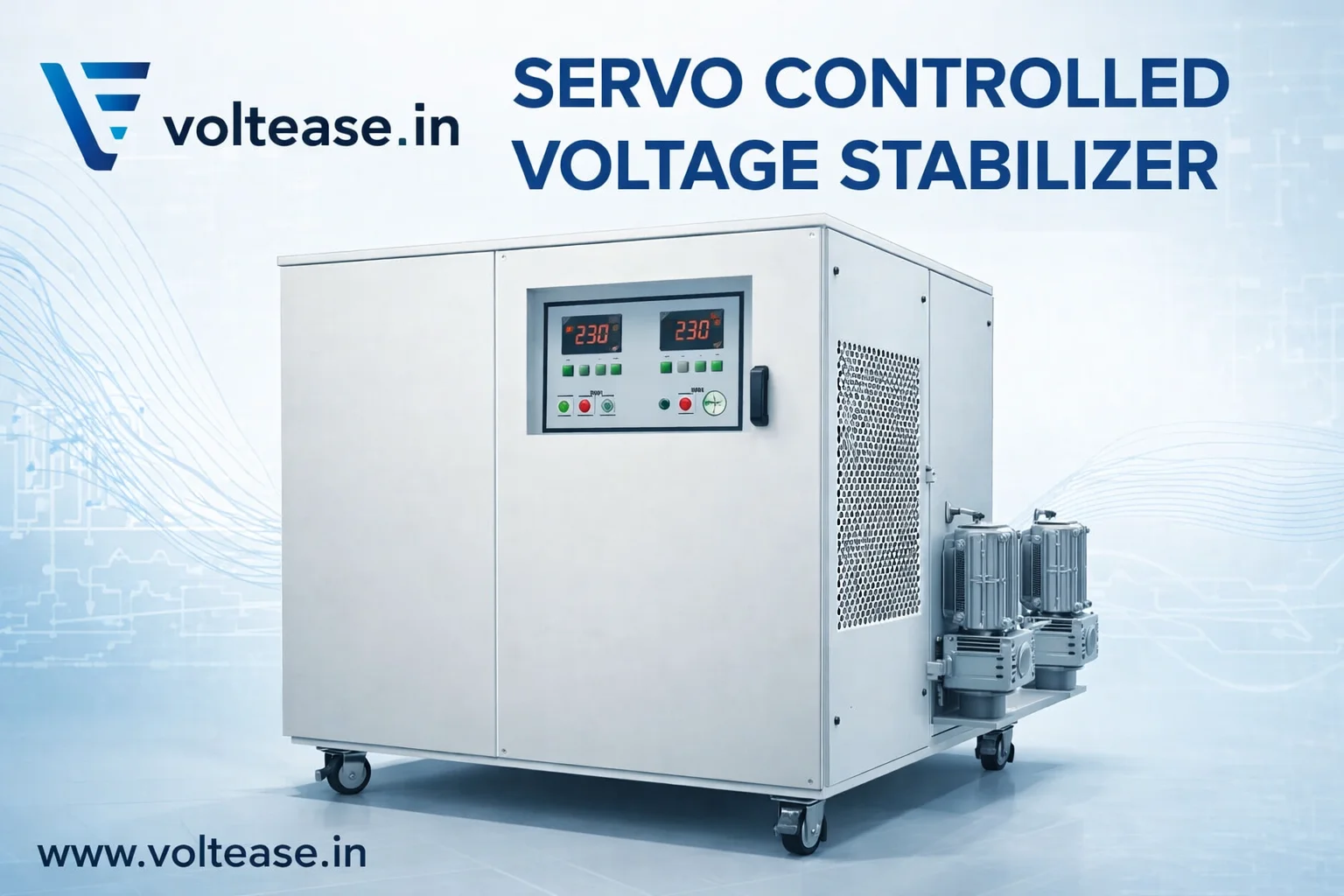
Voltage fluctuations can silently damage costly equipment if not addressed on time. Many studies suggest that nearly 30 to 40% of industrial equipment failures are linked to unstable power supply, and a large share of these issues arise due to delayed maintenance of a servo controlled voltage stabilizer. Identifying early warning signs helps avoid breakdowns, production loss, and expensive repairs. In this blog, we are sharing a few signs that will help determine whether the stabilizer requires repair or replacement or not.
Inconsistent output voltage
A stabilizer is designed to maintain a steady output even when input fluctuates. If you start noticing irregular voltage levels at the output, it is a clear signal that internal components may not be functioning properly. This issue can arise due to worn out carbon brushes, faulty servo motors, or control circuit problems. Ignoring this sign can affect sensitive machinery like CNC machines, medical equipment, or printing units. Regular monitoring of output voltage helps detect this issue early.
Unusual noise or delayed response
A properly functioning stabilizer operates smoothly with minimal sound. If there is unusual humming, clicking, or delayed correction in voltage, it may indicate mechanical or electrical wear. Main causes include:
- Motor gear issues or worn parts
- Loose internal connections
- Dust accumulation affecting movement
Delayed response is especially risky in environments where voltage fluctuations are frequent. That is why it is advised to go for timely inspection of servo controlled voltage stabilizer, so that such problems can be prevented on time.
Frequent tripping or shutdown
If your stabilizer frequently shuts down or trips during operation, it is a warning sign that should not be ignored. This may indicate overload conditions or internal faults. Some of the common reasons include:
- Overheating due to continuous heavy load
- Faulty relays or protection circuits
- Insulation breakdown in winding
Frequent tripping not only interrupts operations but also reduces the life of connected equipment. In such cases, repair or load reassessment becomes necessary.
Visible wear and oil leakage
In oil cooled stabilizers, oil plays a crucial role in insulation and cooling. Any visible leakage or drop in oil level can affect performance and safety. Look for these signs:
- Oil stains near the unit
- Overheating of the stabilizer body
- Burnt smell or discoloration
Such physical signs indicate that maintenance has been overdue and ignoring them can lead to serious internal damage and higher repair costs.
Increased electricity consumption
A faulty stabilizer often consumes more power while delivering less efficient performance. If you notice a sudden rise in electricity bills without an increase in load, your stabilizer could be the reason. This happens when internal components struggle to regulate voltage efficiently. Over time, this not only increases operational costs but also stresses the system. Evaluating performance at this stage helps decide whether repair is sufficient or replacement is the better option.
Conclusion
Recognizing early warning signs can save both equipment and operational costs. A servo controlled voltage stabilizer that shows voltage inconsistency, unusual noise, or frequent tripping requires immediate attention. Timely servicing ensures longer life and better efficiency. At Voltease, we work on both manufacturing premium grade servo voltage stabilizers and also on guiding users with practical solutions so that your stabilizer continues to perform reliably without unexpected disruptions.