
Servo voltage stabilizers are one of the most useful pieces of power conditioning equipment for modern electrical systems. In industrial and commercial spaces, there are numerous appliances, machines and devices that depend on a clean power supply. Though the power supply is optimized for the distribution end, the complex electrical system often leads to voltage disturbances. Resolving these disturbances for each and every load is neither practical nor feasible.
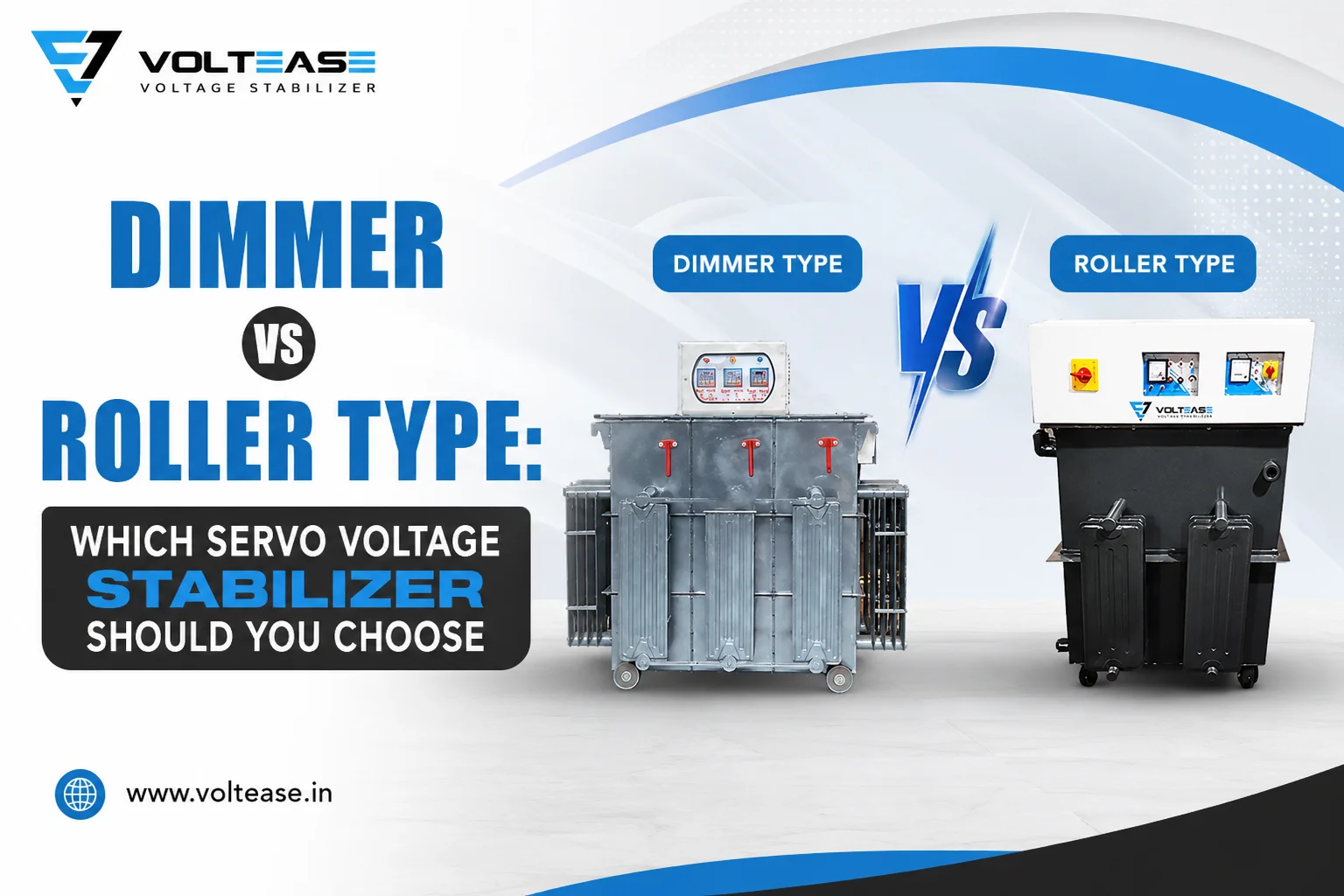
A servo stabilizer works efficiently by correcting the voltage deviations that occur during power flow. Dimmer and roller types are the two major types provided by the servo voltage stabilizer manufacturers. These configurations differ in the cooling method and therefore have a different scope of applications.
Understanding Both Servo Stabilizers
Both the dimmer and roller have the same working principle. The servo motor repositions the carbon brush to adjust the turns ratio in the variac transformer, following which the buck-boost transformer corrects the voltage. But the movement of the carbon brush creates the difference.
Dimmer Type Servo Stabilizer
In the dimmer type stabilizer, the carbon brush rotates over the circular copper winding of the variable transformer. It uses the sliding rolling contact for changing the tap position of the transformer.
Roller Type Servo Stabilizer
The carbon brush in the roller type moves linearly along the copper winding track. The voltage correction accuracy in this is higher, and it can handle industrial loads efficiently.
For better clarity, consider the carbon brush in roller type as a train that moves along the track. And for the dimmer, consider it as a knob that rotates clockwise or anticlockwise.
Comparison Table
Here is a comparison table for clear distinction
| Feature | Roller Type Servo Stabilizer | Dimmer Type Servo Stabilizer |
| Correction Mechanism | Linear roller contact system | Rotary dimmer system |
| Accuracy | Higher accuracy, often around ±1% | Moderate to high accuracy |
| Durability | Better for continuous heavy-duty operation | Good for medium-duty applications |
| Efficiency | Higher efficiency and lower losses | Good efficiency |
| Cost | Higher initial investment | More economical |
| Best suited for | CNC machines, plants, hospitals, printing, and automation | Offices, commercial setups, and smaller industries |
Which One To Choose
The right choice of servo voltage stabilizer depends on the load consumption, operating environment and specific application needs. Here are the tips to choose each of them:
Buyers Should Choose Dimmer Type When:
- The load capacity is moderate.
- The space of installation is limited.
- Needed for commercial or light industrial use.
- Voltage fluctuations are not extremely severe.
- You need an economical stabilizer.
Go For Roller Type Stabilizer When:
- Load capacity is high, including large motors and heavy-duty HVAC systems.
- The equipment is highly sensitive to voltage fluctuations.
- When the stabilizer is needed to perform effectively in a continuous duty cycle.
- The maintenance over the long term is low.
Conclusion
A servo stabilizer works in a continuous duty cycle. The servo voltage stabilizer manufacturers develop different designs based on different operational demands, and dimmer and roller types are the most popular choices. We at Voltease build ISO-compliant servo stabilizers for modern electrical system requirements. They are available in single phase and three-phase variants in a wide range of voltage supplies.