
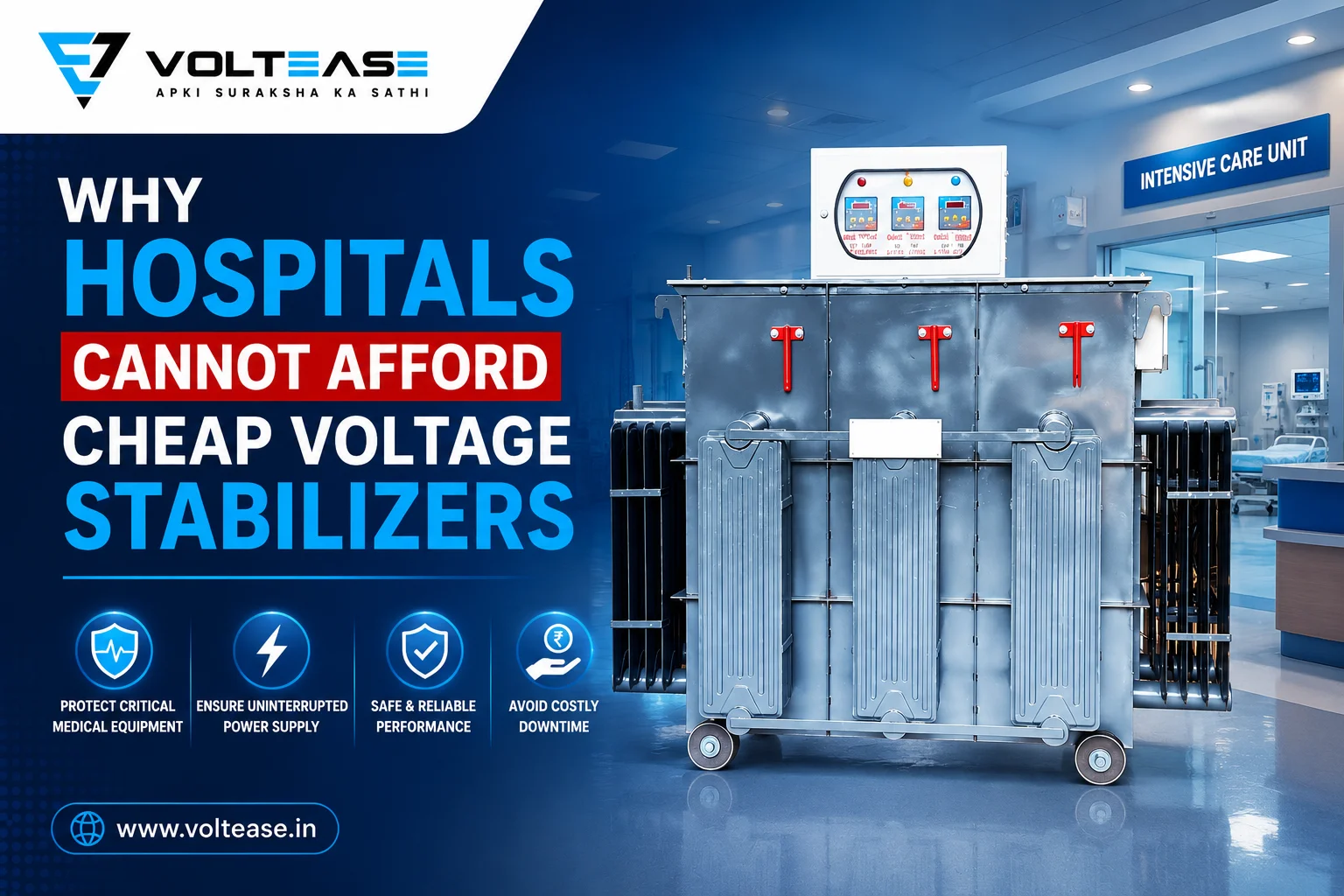
Let me say this clearly.
Electrical failure in hospitals is rarely sudden.
It is cumulative.
Damage builds silently.
And when it shows up — it shows up during surgery, during ICU monitoring, during peak OPD hours.
If you think a basic stabilizer is “good enough” for hospital use — you are gambling not with money but lives.
And life is priceless.
The Reality of Indian Hospital Power
Most Indian hospitals operate within grid voltage tolerance of ±10%.
That means in a 415V three-phase system, voltage can legally swing between:
374V to 456V
And this is considered “acceptable.”
Now add:
● Peak hour load drop
● Sudden restoration after outage
● Diesel generator changeover
● Local transformer overloading
Visit Here: https://www.voltease.in/blog/top-voltage-stabilizer-manufacturers-india/
In one 150-bed hospital project in Lucknow, we recorded incoming voltage for 5 days.
Range observed:
338V to 452V
That is a 114V swing.
No medical equipment likes that.
What Actually Happens to Medical Equipment?
Simple explanation first.
High voltage → Components heat
Low voltage → Current increases
Sudden spike → PCB stress
Now the technical version.
Most modern hospital equipment uses SMPS-based input stages.
Power equation: P = V × I.
When voltage drops, current increases to maintain constant power.
That extra current stresses:
● Rectifiers
● Capacitors
● IGBTs
● Internal transformer windings
Repeated stress reduces lifespan.
Failure doesn’t happen on day one.
It accumulates.
The Hidden Danger: Generator Changeover
This is the most ignored risk.
During mains-to-DG transfer:
● Voltage overshoot
● Frequency instability
● Transient spike
● Neutral disturbance
The spike lasts milliseconds.
But milliseconds are enough.
Cheap stabilizers:
- Have slow correction speed
- Cannot react to fast transients
- Often lack proper surge suppression
And that’s where boards fail.
I have personally seen ventilator boards fail within 14 months in hospitals where power fluctuation was “normal.”
Normal according to grid.
Not normal according to electronics.
The 4-Layer Hospital Power Protection Model
This is what I recommend for any serious hospital setup.
Not just “install stabilizer and forget.”
Layer 1 – Incoming Voltage Monitoring
Record voltage minimum 5–7 days.
Without data, you are guessing.
Layer 2 – Required Servo Calculation
Require Minimum 20–25% extra capacity over maximum demand load.
Not connected load.
Maximum demand.
Correction accuracy ideally ±1%.
Correction speed matters more than brochure design.
Layer 3 – Surge & Transient Protection
Stabilizer does not replace surge protection device (SPD).
They solve different problems.
One handles sustained variation. One handles microsecond spikes.
Layer 4 – Ground Integrity & Neutral Stability
Improper earthing destroys more PCBs than high voltage.
Neutral imbalance causes uneven phase voltage.
Many hospitals ignore this.
Big mistake.
Real Financial Impact (Not Theory)
Let’s talk about real numbers.
Ventilator PCB replacement: ₹45,000 – ₹1,20,000 Pathology analyzer SMPS: ₹60,000+ OT light driver board: ₹35,000+ MRI downtime per day: ₹3–5 lakh loss
Now compare that to difference between:
Common Mistakes I See in Hospitals
1. Buying Per kVA Rate
“100 kVA ka rate batao.”
That is procurement thinking.
Not protection thinking.
Ask instead:
● Copper winding weight?
● Insulation class?
● Short circuit withstand rating?
● Correction speed in volts per second?
● Accuracy band?
If supplier hesitates — that’s your signal.
2. Exact Load Sizing (No Margin)
Hospital load fluctuates:
● Lift start
● HVAC cycle
● Imaging equipment ramp-up
● Autoclave heaters
If stabilizer rating equals connected load — it will struggle daily.
Undersizing doesn’t fail immediately.
It overheats slowly.
3. Aluminum Winding Sold as Copper
This still happens.
Lower cost. Higher heating. Reduced lifespan.
Unless you verify weight and cross-section — you won’t know. Or better, you should visit physically at the time of manufacturing.
Hack:- Send some junior executive and ask him to make the video to verify. I agree it will take some time and money but the profits you will earn will justify the cost.
4. No Harmonic Consideration
Medical equipment generates harmonics.
If transformer not designed with proper K-factor tolerance:
● Excess heating
● Audible noise
● Insulation stress
This is rarely discussed during sales.
Air Cooled vs Oil Cooled – What Actually Matters
Air Cooled:
● Suitable for moderate kVA
● Compact
● Indoor friendly
● Requires airflow clearance
Oil Cooled:
● Better heat dissipation
● Suitable for higher capacities
● Longer duty cycle endurance
But oil type inside building must be planned properly.
Ventilation. Fire compliance. Space.
Blind installation is irresponsible.
What Most Sellers Will Not Tell You
Let me be straight.
To reduce cost, many manufacturers:
● Reduce copper cross-section
● Use lower grade servo motors
● Use slower sensing PCBs
● Quote ±3% but advertise as “high precision”
● Skip about protection add ons.
Customer assumes all 100 kVA units are equal.
They are not.
Practical Buying Checklist for Hospital Administrators
Before approving any stabilizer:
● Record 7-day voltage log
● Measure maximum demand load
● Add minimum 20–25% margin
● Confirm copper winding physically
● Ask correction speed (not just accuracy)
● Confirm short circuit withstand rating
● Ask harmonic handling capability
● Check service response commitment in writing
● Verify earthing resistance on site
● Ensure separate surge protection device
● Take all the add on features of protection like HIgh low cut off and single phase prevention
● Ask for a bypass facility if not present on site.
If supplier cannot answer technically — reconsider.
If You Think “We Never Had Issue”
That only means the threshold hasn’t been crossed.
Electrical stress is cumulative.
Boards don’t fail dramatically every time.
They weaken.
Then fail when you least expect.
Usually during peak usage.
Final Thought
Hospitals insure buildings.
They insure equipment.
They insure liability.
But electrical protection is treated like a commodity purchase.
That thinking needs correction.
At Voltease, we don’t sell by kVA rate.
- We evaluate load.
- We study voltage.
- We design margin.
- We explain risk clearly.
Because in hospital environments, protection is not optional engineering.
It is operational responsibility.
If you want to start correctly, begin with a voltage study.
Everything else comes after that.
—
Faisal Siddiqui
Voltease